Saturday, February 25, 2012

Big Water


Most snorkel trips I go on involve crawling along in a few feet of water, with the bottom usually in easy arms reach. I am regularly amazed by the power of water. Experiencing one of earth’s elemental forces is one of the draws of creek snorkeling. But I can usually hold my own by hanging on. That isn’t the case on Muddy Creek.

The Muddy flows through a deeply cut gorge, forested in old hemlock. It is secluded, and I feel like I am in the Pacific Northwest or anywhere else much more remote than here which is only an hour from both Philadelphia and Baltimore. The water is blue green clear and big compared to most rivers in my area.

Ropy bands of smoothed schist plunge into the water as a sheer wall. Water carved chutes are too smooth to hold against the current and the eddy pushes me upstream, and then out into the main turbulent flow. I can make out the outlines of smooth scalloped bedrock sheets eight feet below as I swim hard across the current to an eddy on the opposite shore and get swirled upstream again over a large peaked sandbar.

The circular current pushes me out into the main flow where I am swept downstream across the river into the eddy, pushed upstream and back out across the flow in what would be a perpetual figure 8, if I didn’t grab a smoothed nub of schist in shallower water. It’s a pretty incredible rush, akin to weightless flying.

I picked my head out of the water and viewed the river from water level. A small hatch of small flies flittered away from the surface. Water continued to flow, and the eddies swirled. I have seen Muddy Creek dozens of times from a kayak, but this one short trip gave me a completely different perspective and appreciation for the forces that shape this place.

Sunday, February 19, 2012

Cold Focus


The last time I was in Principio Creek, there was 6 inches of visibility, partly because of high spring flows, and partly because of the soup millions of herring eggs swirled in the current makes. Today was different. There weren’t any herring, and no eggs, but in exchange the water was incredibly clear. I slipped into the stream in a deep pool downstream of the falls, where migratory fish often congregate before making a push up the falls, to breach the fall line, the dividing line between coastal plane and piedmont. The principio is one of those no mans land streams, not quite coastal plane, not quite piedmont, but the transition between the two. It is neither and both. I hoped to see some of the early migrants holding in the large pool - some herring, or maybe some yellow perch. Instead I saw darters, and had to wonder if these fish were in the throes of reproduction, as abundant as they were. Two or three shot out from their cobbled cranny hiding spots each time I grabbed a new hold as I crawled upstream.

A large school of river chub shot around my right flank. I spun around to chase them, to try to get a shot and soon I was among a 50 strong school. The water was painfully cold, cold enough that my teeth felt like I bit ice cream. But none of that registered anymore. In the instant I found myself in the midst of all of those fish, my world narrowed to me, this stream and these fish. As usual, creek snorkeling put me into the here and now and all the thoughts of yesterday and tomorrow were gone. I had a focused acuity I have only ever experienced underwater.

The skittish river chub outswam me, but the tessellated darters were more reluctant to swim from their protective stones, so they tolerated my close approach. Tessellateds are one of those fish I am used to. I see them on almost every trip. And yet, like other common fish, they still hold my attention and fascination. I love how their bodies just kind of limply conform to the cobbles, and just when I think the river just pushes them around, they muster an incredible burst of energy and master the current to put distance between me and them. I love how their large pectoral fins hold them to the bottom and almost irridesce blue, and I love how some individuals allow my camera to get within inches while others scatter when I’m still feet away. A lone crayfish sits out exposed on a sand bar and its brilliant red color is striking. The usual never gets mundane.

There is always the fascination with the familiar in streams and maybe that’s why time becomes focused, and compressed to the moment. Maybe the focus comes from experiencing the stream on the streams terms, and learning about the life of the stream from its vantage point rather than ours. The more I snorkel streams, the more I realize that we have a lot to learn.

Tuesday, February 14, 2012

The Love of Streams


It’s my parents’ anniversary today, so it’s fitting for me to celebrate and remember by snorkeling a creek. My dad gave me my first underwater experience. I stood on a rock in water over my head with mask and snorkel on, but too afraid to put my head in the water. He gently nudged me off the rock so I had no choice but to look below and a whole other world was revealed. I’ve never been the same since. He took SCUBA classes with me in 7th grade, and they always supported me being in a creek. They fostered my love for streams, and I miss them terribly, so a fitting tribute is to get in the water, to explore.

Stoney Creek is a non-descript suburbanizing stream. And it has the typical features you would expect to see where houses are taking over woods. The stream is far from pristine, and while it’s not trash filled, it isn’t clean. Stream corridors make convenient routes for sanitary sewer mains, and Stoney Creek isn’t any different. Manhole monuments of concrete and steel rise 5 feet above the floodplain. Amtrak trains scream though a thin veil of woods that hides them from sight, and the back of a new shopping center perches on a hill overlooking the stream. A homeless encampment of three tents sits in the skinny strip of woods between the creek and shopping center. It’s a typical stream, tucked into the folds of suburbia and forgotten.

I slipped beneath the surface, and as usual a whole new world appeared. Algae covers everything and creates an otherworldly scene. While the view was interesting, it was also expected. This much algal growth is a sign of an over fertilized creek, and most of our suburban streams are over fertilized by nutrients that run off of our yards and streets. But even in its impacted state, Stoney Creek still had a certain beauty about it, just not a pristine beauty.

I figured this trip would be mostly about witnessing incredible stream scapes and geologic architecture rather than seeing life. The water was extremely cold, and after just a few minutes it penetrated my dry suit and insulating layer and chilled through to my skin. Knives of cold stabbed my exposed face the minute I got in the water, and now my thighs were starting to sting. I saw a lone caddis fly on a rock and as I watched the cadis graze, a sculpin darted from under a cobble out into the open.

Sculpin are predatory, and this one had large down turned puffy lips that defined the edges of a mouth that took up most of the fishes face, and a tapered body shape camouflaged in mottled tan and grey. A bright orange band framed the edge of its dorsal fin. Perfectly constructed for an ambush predator. This fish lies well hidden and waits for an unsuspecting darter, or other small fish to wander by when it explosively snatches the prey. This was a special fish for me as I have never seen a sculpin in this area, and certainly didn’t expect to see one in this stream, in this suburbanized, sewer lined, forgotten stream.

It might be suburbanized, it may be forgotten, but this fish is a good reason to remember all the experiences I have had in suburbanizing streams. It’s a good reason to continue to explore and witness all the incredibly unexpected sights and natural drama, and to remember the people who have fostered my love for streams, even ones that some would consider unlovable.

Thursday, February 2, 2012

Suburban Stream


I slipped into the water and really questioned the sanity of it all. The unforested lawns of a trailer park flanked the creek just upstream. There aren’t any forested buffers to protect it from the things we do on land that affect water quality like fertilize lawns, wash cars and salt walks. There are no trees to soak up excess nutrients before they reach the stream, or to hold soil in place. We had a little rain this morning, barely a tenth of an inch, and that was enough to cloud the water.

It’s obvious this is an impacted stream, over fertilized and muddy with sediment. But there are no throw away streams. There aren’t any disposable creeks. Each one has value and worth, and there is beauty in them all. It just took a few minutes for this stretch of Stone Run to reveal its splendor to me today.

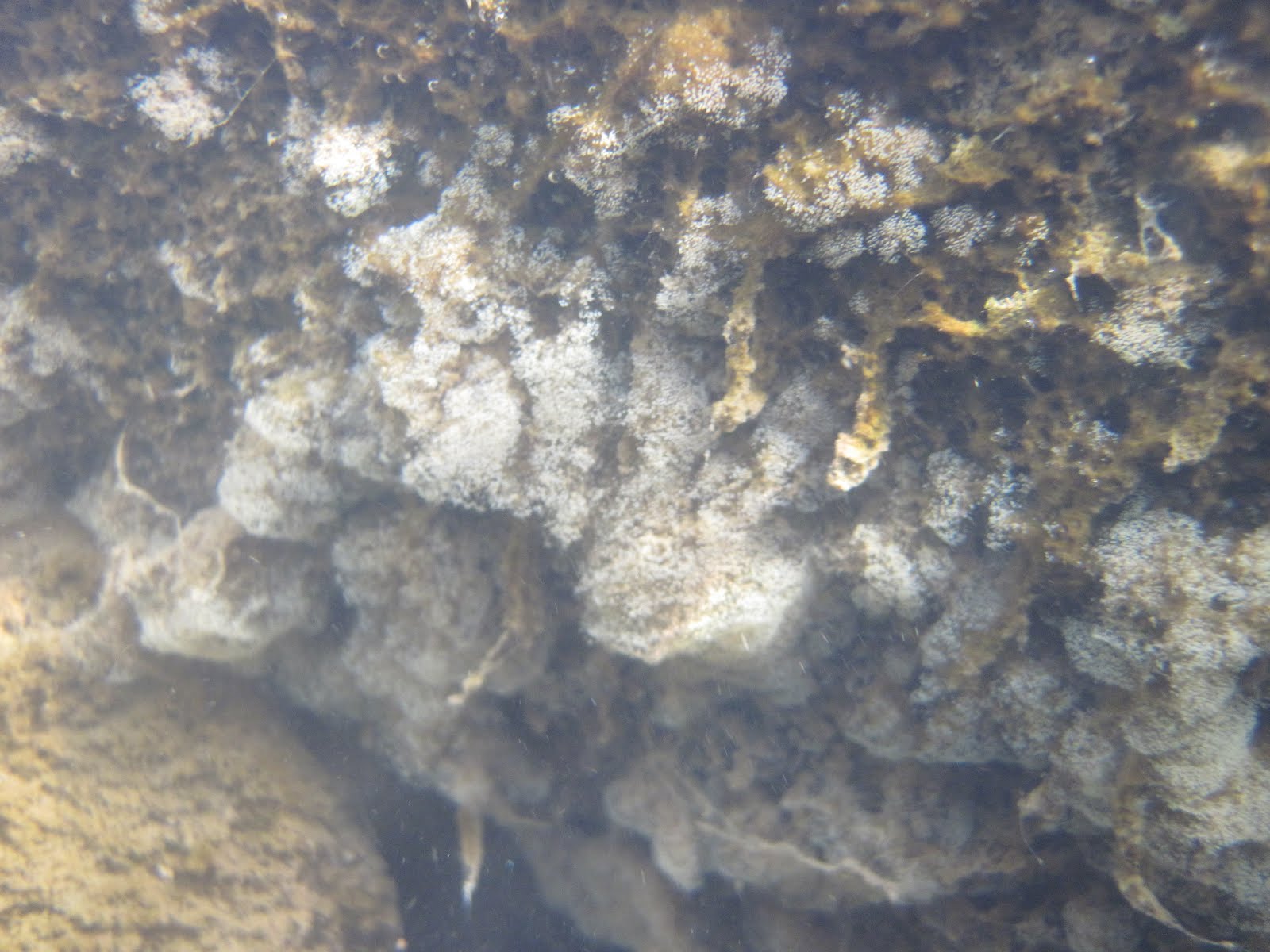
White and olive algae and bacteria biofilms cover rocks and create an otherworldly brilliance.
Roots that dangle into the water from the undercut bank are covered in golden biofilm and look like locks of course blonde hair. Always there is life, and life is always incredible.

I floated over a deeper hole and thought how I need to return in spring, when things warm and mating starts. I bet this hole is chock full with fish. Just then three river chubs darted underneath, with the copper fringe of their gill covers and pectoral fins glowing through the smoky water. I turned to follow and found a small school of fat dace trailing. Life is here in abundance now. I do have to return in spring.

Monday, January 30, 2012

Mid-Winter Swim


There’s about a month to go till things start to come alive again around here. Not that things are really dead. Life is there, it’s just not as active and noticeable. It’s nuzzled down into the cobbles instead of flying over the bottom. It has been a warm season, and while most days it hasn’t felt like it, it is still winter and things, while present, are more muted.

We haven’t had any ice on our creeks and I’m starting to wonder if we will ice over this season at all. Not that I particularly enjoy snorkeling in ice, but ice is part of the system, and its absence is a departure from normal. Not good, not bad, but different, and different has an effect. I wonder what effect no ice will have on our stream ecosystems if in fact we remain ice free for the next month.

Temperatures are off, but everything else points to winter. The sun sits low in the sky and long shadows are cast early. The stream valley is grey by four. Cold knife points of frigid water stab my face and hands as I crawl upstream. Caddisfly larvae have sealed the openings of their cases with quartz grains as they usually do right about now.

Other caddis are still out grazing. A Northern case maker caddisfly is clawing at a smooth cobble, as it tries to get a firm grip to hold against the current. A blast of water blows the caddisfly off the rock, and a single thread keeps it tethered. Its twig case vibrates violently like a kite in a storm, drops to the bottom, scrambles for a good grip and gets blown into the water column again. If fish were out and active this insect would have been eaten long ago.

I want to explore more, to see who is out and who isn’t. To see who is struggling to hang on and who is just waiting till water temperatures increase and the flourish of spring life ensues. But my hands become painfully cold after just 20 minutes in the water, and it’s time to leave. There is always amazing life in our streams, even our most common ones.

Sunday, January 15, 2012

Unsung Heroes of Water Quality


The term ‘hero’ is way overused. Chevy recently called NFL players “unsung heroes”. Really Chevy? Heroes? For what? And I think a couple million dollar contract is pretty well sung. But when it comes to water quality, especially estuarine and specifically Chesapeake Bay water quality, one key player in that goes unmentioned. We hear time and again how if we could restore the Chesapeake’s oyster population, we could restore water quality. And that’s true. Oysters are amazing filters, and restoring the Chesapeake’s oysters would go a long way in restoring water quality. But the Bays problems start way up watershed, and so too do the solutions to the problem, partly in the form of, well an unsung hero of water quality.
I drift out from the bank into big open water of the Susquehanna. Conowingo dam isn’t running right now, so the water is low and its easy for me to drift away from the shore without getting swept downstream. There is supposed to be an incredible mussel bed in this area somewhere. I instantly see thousands of Asian clam shells, an invasive imported to North America when Chinese Immigrants come to build our railroads. The clams have marched across this, and every other temperate continent, and some call this animal the most invasive freshwater organism on the planet. A few more feet out and I start to see dead mussel shell, patina green on white with mother of pearl spots where the adductor mussels attached when the animal was alive. I was hoping to find some live ones. While eastern elliptio mussles aren’t endangered, there aren’t many young entering the population in the Susquehanna River, especially upstream of the Conowingo dam. We haven’t seen a population decline yet we think because elliptios are very long lived…possibly 100 years, so the death of the old timers hasn’t quite caught up with the lack of young to affect the number of mussels. I hope to see some small ones.
Mussles do a great job of blending in so most people don’t know they are there, and most people, including estuarine scientists, don’t realize their water filtering abilities. Bill Lellis from the USGS researched the filtering capacity of the elliptio population in the Delaware River and found that they filter between 2 and 6 billion gallons of water per day. I have a hard time conceptualizing 2-6 billion so just as a point of reference, Baltimore City “only” uses about 50 million gallons per day. Freshwater mussels can do the heavy lifting of water filtration and therefore water quality improvement.
Finally I see the frills and open slit of an incurrent syphon. Then another and another. I am finally on the bed, and just relax, drift and enjoy watching these unsung heroes of water quality do their thing: filter water headed to the Chesapeake. We devote a lot of time and attention to restoring oysters to the Chesapeake, in the name of water quality. Maybe we should do the same for the unsung filtering heroes, the fresh water mussels of our up watershed rivers and streams.

Friday, January 6, 2012

Water Quality Starts Here


Stone Run isn’t much to look at. There really isn’t much to it. It is a small stream that flows through hay fields and suburban yards, and according to a study done by the Center for Watershed Protection (www.cwp.org), it’s one of the tributaries to the Octoraro Creek with the most problems which include high levels of nutrients, impaired stream habitat and impacted biota. It’s an everyday stream, one that flows through our neighborhoods, one that we all see but hardly notice as we hustle through our daily schedules.

There are a few sections that hold a lot of hope since they have excellent habitat, and diverse biota. But overall, Stone Run is a poor quality stream. The particular stretch I was about to enter didn’t hold much promise either. It was rated as poor based on stream habitat, connection to the floodplain, and biota diversity. A sewage treatment lagoon was on one bank and a pasture on the other. The reach was just below route 1. I didn’t expect to see much, and questioned the sanity of going through the hassle of putting all this gear on to get into freezing water to see nothing.

The substrate seemed fake. Imported stone brought in to keep the outside bank from eroding through to the sewage lagoon, and stone left over from route 1 construction mixed with the native geology. It all looked artificial and out of place. But there was life here and where there is life, there is hope. Caddis grazed in the riffles and common shiners foraged in the eddies. I could have laid there for hours watching the caddis in their crystalline particle cases clean algae from the rocks, but it didn’t take long for the cold to penetrate the layers through to my skin.

There is hope for even this impaired section of stream. The Center for Watershed Protection and the Octoraro Creek Watershed Association (www.theowa.org) have come up with a list concrete, realistic actions that will improve the quality of Stone Run. Some of these are easy things we can all do like install rain barrels and rain gardens and plant forested buffers. Water quality starts here in this tiny stream, with these simple actions.