Tuesday, February 14, 2012

The Love of Streams


It’s my parents’ anniversary today, so it’s fitting for me to celebrate and remember by snorkeling a creek. My dad gave me my first underwater experience. I stood on a rock in water over my head with mask and snorkel on, but too afraid to put my head in the water. He gently nudged me off the rock so I had no choice but to look below and a whole other world was revealed. I’ve never been the same since. He took SCUBA classes with me in 7th grade, and they always supported me being in a creek. They fostered my love for streams, and I miss them terribly, so a fitting tribute is to get in the water, to explore.

Stoney Creek is a non-descript suburbanizing stream. And it has the typical features you would expect to see where houses are taking over woods. The stream is far from pristine, and while it’s not trash filled, it isn’t clean. Stream corridors make convenient routes for sanitary sewer mains, and Stoney Creek isn’t any different. Manhole monuments of concrete and steel rise 5 feet above the floodplain. Amtrak trains scream though a thin veil of woods that hides them from sight, and the back of a new shopping center perches on a hill overlooking the stream. A homeless encampment of three tents sits in the skinny strip of woods between the creek and shopping center. It’s a typical stream, tucked into the folds of suburbia and forgotten.

I slipped beneath the surface, and as usual a whole new world appeared. Algae covers everything and creates an otherworldly scene. While the view was interesting, it was also expected. This much algal growth is a sign of an over fertilized creek, and most of our suburban streams are over fertilized by nutrients that run off of our yards and streets. But even in its impacted state, Stoney Creek still had a certain beauty about it, just not a pristine beauty.

I figured this trip would be mostly about witnessing incredible stream scapes and geologic architecture rather than seeing life. The water was extremely cold, and after just a few minutes it penetrated my dry suit and insulating layer and chilled through to my skin. Knives of cold stabbed my exposed face the minute I got in the water, and now my thighs were starting to sting. I saw a lone caddis fly on a rock and as I watched the cadis graze, a sculpin darted from under a cobble out into the open.

Sculpin are predatory, and this one had large down turned puffy lips that defined the edges of a mouth that took up most of the fishes face, and a tapered body shape camouflaged in mottled tan and grey. A bright orange band framed the edge of its dorsal fin. Perfectly constructed for an ambush predator. This fish lies well hidden and waits for an unsuspecting darter, or other small fish to wander by when it explosively snatches the prey. This was a special fish for me as I have never seen a sculpin in this area, and certainly didn’t expect to see one in this stream, in this suburbanized, sewer lined, forgotten stream.

It might be suburbanized, it may be forgotten, but this fish is a good reason to remember all the experiences I have had in suburbanizing streams. It’s a good reason to continue to explore and witness all the incredibly unexpected sights and natural drama, and to remember the people who have fostered my love for streams, even ones that some would consider unlovable.

Thursday, February 2, 2012

Suburban Stream


I slipped into the water and really questioned the sanity of it all. The unforested lawns of a trailer park flanked the creek just upstream. There aren’t any forested buffers to protect it from the things we do on land that affect water quality like fertilize lawns, wash cars and salt walks. There are no trees to soak up excess nutrients before they reach the stream, or to hold soil in place. We had a little rain this morning, barely a tenth of an inch, and that was enough to cloud the water.

It’s obvious this is an impacted stream, over fertilized and muddy with sediment. But there are no throw away streams. There aren’t any disposable creeks. Each one has value and worth, and there is beauty in them all. It just took a few minutes for this stretch of Stone Run to reveal its splendor to me today.

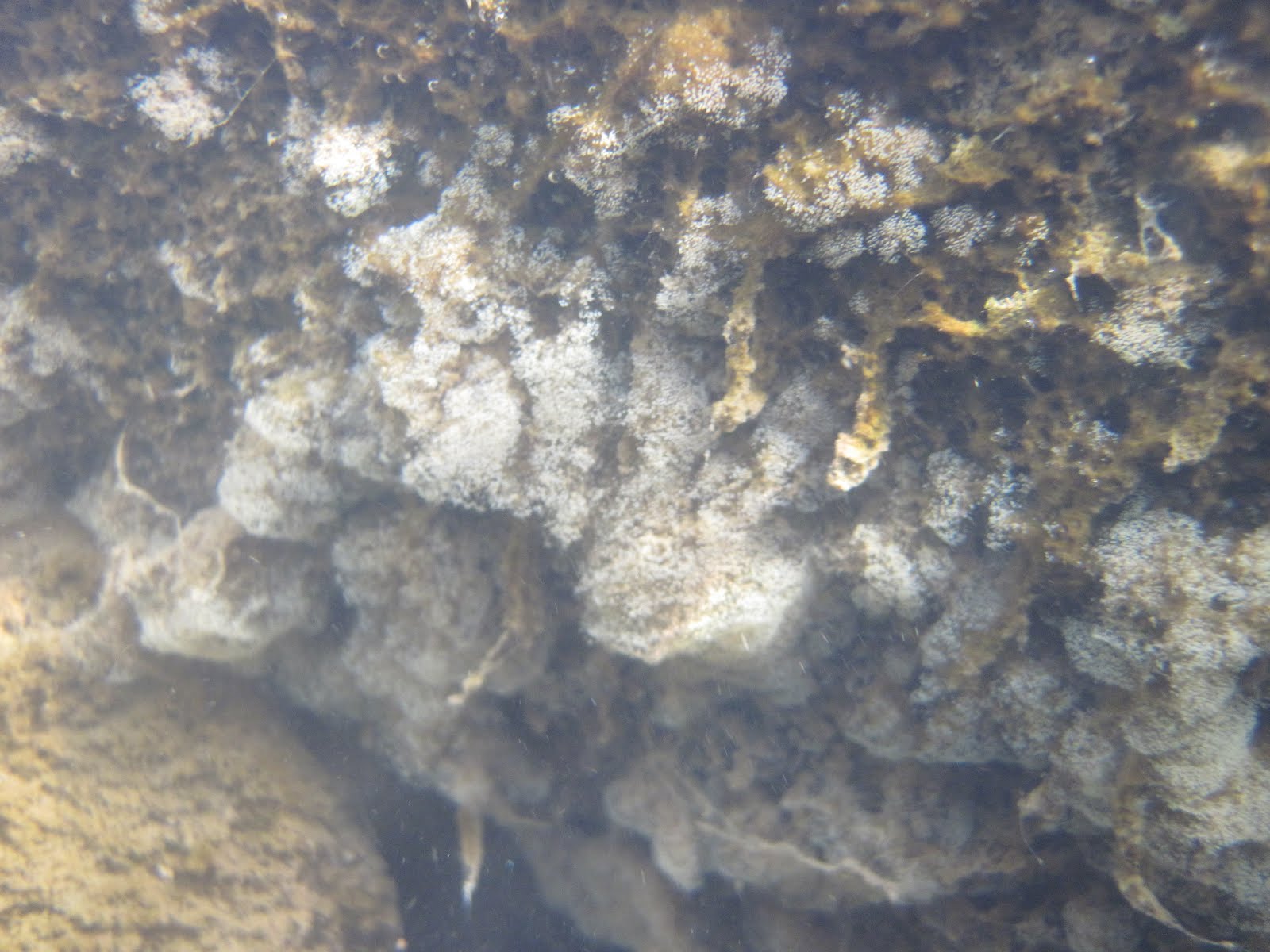
White and olive algae and bacteria biofilms cover rocks and create an otherworldly brilliance.
Roots that dangle into the water from the undercut bank are covered in golden biofilm and look like locks of course blonde hair. Always there is life, and life is always incredible.

I floated over a deeper hole and thought how I need to return in spring, when things warm and mating starts. I bet this hole is chock full with fish. Just then three river chubs darted underneath, with the copper fringe of their gill covers and pectoral fins glowing through the smoky water. I turned to follow and found a small school of fat dace trailing. Life is here in abundance now. I do have to return in spring.

Monday, January 30, 2012

Mid-Winter Swim


There’s about a month to go till things start to come alive again around here. Not that things are really dead. Life is there, it’s just not as active and noticeable. It’s nuzzled down into the cobbles instead of flying over the bottom. It has been a warm season, and while most days it hasn’t felt like it, it is still winter and things, while present, are more muted.

We haven’t had any ice on our creeks and I’m starting to wonder if we will ice over this season at all. Not that I particularly enjoy snorkeling in ice, but ice is part of the system, and its absence is a departure from normal. Not good, not bad, but different, and different has an effect. I wonder what effect no ice will have on our stream ecosystems if in fact we remain ice free for the next month.

Temperatures are off, but everything else points to winter. The sun sits low in the sky and long shadows are cast early. The stream valley is grey by four. Cold knife points of frigid water stab my face and hands as I crawl upstream. Caddisfly larvae have sealed the openings of their cases with quartz grains as they usually do right about now.

Other caddis are still out grazing. A Northern case maker caddisfly is clawing at a smooth cobble, as it tries to get a firm grip to hold against the current. A blast of water blows the caddisfly off the rock, and a single thread keeps it tethered. Its twig case vibrates violently like a kite in a storm, drops to the bottom, scrambles for a good grip and gets blown into the water column again. If fish were out and active this insect would have been eaten long ago.

I want to explore more, to see who is out and who isn’t. To see who is struggling to hang on and who is just waiting till water temperatures increase and the flourish of spring life ensues. But my hands become painfully cold after just 20 minutes in the water, and it’s time to leave. There is always amazing life in our streams, even our most common ones.

Sunday, January 15, 2012

Unsung Heroes of Water Quality


The term ‘hero’ is way overused. Chevy recently called NFL players “unsung heroes”. Really Chevy? Heroes? For what? And I think a couple million dollar contract is pretty well sung. But when it comes to water quality, especially estuarine and specifically Chesapeake Bay water quality, one key player in that goes unmentioned. We hear time and again how if we could restore the Chesapeake’s oyster population, we could restore water quality. And that’s true. Oysters are amazing filters, and restoring the Chesapeake’s oysters would go a long way in restoring water quality. But the Bays problems start way up watershed, and so too do the solutions to the problem, partly in the form of, well an unsung hero of water quality.
I drift out from the bank into big open water of the Susquehanna. Conowingo dam isn’t running right now, so the water is low and its easy for me to drift away from the shore without getting swept downstream. There is supposed to be an incredible mussel bed in this area somewhere. I instantly see thousands of Asian clam shells, an invasive imported to North America when Chinese Immigrants come to build our railroads. The clams have marched across this, and every other temperate continent, and some call this animal the most invasive freshwater organism on the planet. A few more feet out and I start to see dead mussel shell, patina green on white with mother of pearl spots where the adductor mussels attached when the animal was alive. I was hoping to find some live ones. While eastern elliptio mussles aren’t endangered, there aren’t many young entering the population in the Susquehanna River, especially upstream of the Conowingo dam. We haven’t seen a population decline yet we think because elliptios are very long lived…possibly 100 years, so the death of the old timers hasn’t quite caught up with the lack of young to affect the number of mussels. I hope to see some small ones.
Mussles do a great job of blending in so most people don’t know they are there, and most people, including estuarine scientists, don’t realize their water filtering abilities. Bill Lellis from the USGS researched the filtering capacity of the elliptio population in the Delaware River and found that they filter between 2 and 6 billion gallons of water per day. I have a hard time conceptualizing 2-6 billion so just as a point of reference, Baltimore City “only” uses about 50 million gallons per day. Freshwater mussels can do the heavy lifting of water filtration and therefore water quality improvement.
Finally I see the frills and open slit of an incurrent syphon. Then another and another. I am finally on the bed, and just relax, drift and enjoy watching these unsung heroes of water quality do their thing: filter water headed to the Chesapeake. We devote a lot of time and attention to restoring oysters to the Chesapeake, in the name of water quality. Maybe we should do the same for the unsung filtering heroes, the fresh water mussels of our up watershed rivers and streams.

Friday, January 6, 2012

Water Quality Starts Here


Stone Run isn’t much to look at. There really isn’t much to it. It is a small stream that flows through hay fields and suburban yards, and according to a study done by the Center for Watershed Protection (www.cwp.org), it’s one of the tributaries to the Octoraro Creek with the most problems which include high levels of nutrients, impaired stream habitat and impacted biota. It’s an everyday stream, one that flows through our neighborhoods, one that we all see but hardly notice as we hustle through our daily schedules.

There are a few sections that hold a lot of hope since they have excellent habitat, and diverse biota. But overall, Stone Run is a poor quality stream. The particular stretch I was about to enter didn’t hold much promise either. It was rated as poor based on stream habitat, connection to the floodplain, and biota diversity. A sewage treatment lagoon was on one bank and a pasture on the other. The reach was just below route 1. I didn’t expect to see much, and questioned the sanity of going through the hassle of putting all this gear on to get into freezing water to see nothing.

The substrate seemed fake. Imported stone brought in to keep the outside bank from eroding through to the sewage lagoon, and stone left over from route 1 construction mixed with the native geology. It all looked artificial and out of place. But there was life here and where there is life, there is hope. Caddis grazed in the riffles and common shiners foraged in the eddies. I could have laid there for hours watching the caddis in their crystalline particle cases clean algae from the rocks, but it didn’t take long for the cold to penetrate the layers through to my skin.

There is hope for even this impaired section of stream. The Center for Watershed Protection and the Octoraro Creek Watershed Association (www.theowa.org) have come up with a list concrete, realistic actions that will improve the quality of Stone Run. Some of these are easy things we can all do like install rain barrels and rain gardens and plant forested buffers. Water quality starts here in this tiny stream, with these simple actions.

Friday, December 23, 2011

Snorkeling on the Shortest Day


The winter solstice, the shortest day of the year, has been celebrated since ancient times. It’s the beginning of winter here in the northern hemisphere, but more importantly, it’s the beginning of the end of the dark. It’s a celebration of hope that more light than dark will return. It’s a celebration of hope that things will get warm again.

I figured I’d spend at least part of the solstice in Basin Run. This has become a bit of a ritual for me. I have jumped into the same pool in Basin Run as a way of welcoming winter for the last three years. It’s more of a reminder to me that even though it’s getting colder out, and water temperatures are to the point where I can only stay in for 30 minutes or so before my hands are non-functional, I can still snorkel. I can still explore our streams through the winter. There are still things to learn beneath the ice. But more than anything I want to tell the passage of time by changes in the world rather than a flipped page of a calendar. Getting into Basin Run and other streams regularly throughout the year, regardless of weather, lets me track the year through seasonal transformations of our rivers.

I laid down and crept upstream. The cold stung as usual, but the water clarity was incredible. Case maker caddisfly larvae covered everything. Their sand grain cases dotted every rock and boulder, and the black larvae inside dutifully grazed on algae. There wasn’t a lot of algae covering the structure of this stream, possibly because the caddis kept it in check. I can witness stream ecology in action any day of the year. I just need to look for it.

I’ve been worried about Basin Run. It’s my go to creek. Basin Run is five minutes from my house, and is still a high quality stream. Most of its watershed is still forested and while other streams run murky for days after a rain, Basin Run typically flows clear.

It’s a beautiful little steam that still retains a lot of its character, but its watershed is developing which usually means murkier water. But the water still runs clear and the creek affords incredible views, and as I watch this herd of case maker caddis larvae graze, and black nosed dace sluggishly nestle into the gravel bottom, I feel my worry dissolve to hope.

There is hope for this stream and every other one. Hope that we have learned from our past transgressions and changed our behaviors that resulted in polluted, murky water. There is hope that this knowledge protects streams like Basin Run. There is hope that water quality and diversity will return as we work to remedy more impacted streams like Herring Run, and the Jones Falls in Baltimore City. There is hope that there will be more light than dark, and clear water will return.

Sunday, December 18, 2011

So Much River, So Little Time


Part of the draw of creek and river snorkeling is witnessing the brilliance of fresh water life. Part of it is exploring areas most haven’t seen underwater, and part of it is experiencing creeks and rivers on their terms. This trip was more about experiencing the Susquehanna on its terms than it was about witnessing riverine ecology in action, and that made me a little nervous.

The water was murky and cold and if things went just a little wrong, I could find myself in a lot of trouble. I was going to snorkel a three mile section of the Susquehanna from Octoraro Creek to just north of Port Deposit. This isn’t a particularly dangerous part of river. There aren’t any killer rapids, but a lot of people have died here. It was cold, so if one thing went wrong that caused me to be on the river for longer than planned, or if my drysuit failed for any reason, I was at real risk of becoming hypothermic. Then there were the usual drowning hazards.

I was familiar with this section of river, which heightened my caution. This stretch was controlled by the Conowingo Dam, or as controlled as we fool ourselves that dams control. Ultimately the river does what it wants when it wants, and each spring the lower Susquehanna reminds us all of that fact when she floods, in spite of Conowingo. But today the dam dictated the river, so water levels changed drastically in an instant. The risks I mentally listed included strainers and rocks. I wanted to make sure to swim clear of the heads of islands, rocks, and anything else that might catch and hold logs in the water that strain the water through them, but capture larger objects, like me. Strainers are usually fatal. One wrong rocky snag on my dry suit and I would be exposed to 39 degree water, and 29 degree air. Access to this stretch of river was limited so while I don’t consider it remote, rescue is difficult. If something went wrong, I was on my own. River snorkeling is largely a safe activity, but extra caution was warranted.

The river was flowing at 10,000 cubic feet per second, gauge height was at 11 feet when I left my truck at the take out and I figured one of the problems I might face was the shallow nature of the river. If I had to repeatedly walk, my on water time would be longer than what I wanted given the cold. The Susquehanna’s rocky snaggle toothed character was evident through the low water. By the time I was dropped off at the put in 3 miles upstream, the dam was flowing 50,000 cubic feet per second, the river rose 3 feet, and my worry was now too much water, too fast that could drive me into a strainer or exposed rock. I wouldn’t have much control relative to the force of the river.

I flowed out from the Octoraro and hoped the visibility would improve once I was clear of its muddy trail. I only saw tan. Finally the bottom came into view and blurred past as I approached the head of a gravel bar submerged by the rising flow. I swam towards the middle of the river, and floated with the current. An immature eagle circled close overhead, and seemed curious about what I was. A mature eagle took flight from a shore line tree when I was next to it and multiple herons grunted off rocks as I passed.

Unseen rock behemoths forced large mushroom waves of water up from the bottom. Leaves that fell and entered the river this autumn were churned up with other bits of detritus that were swirled and pulverized. This is the food that drives much of the river ecosystem, and every time I approached a place where the water was forced up, I witnessed this process of detritus cycling that is so critical to the rivers ecology

Occasionally large rocks emerged through the murk then disappeared just as fast, but for the most part, I only felt their effects. I learned that splashing on the horizon meant the approach of a rapid, and so I occasionally lifted my face from the water to scan downstream. I wanted to spend more time in the rapids, to play in the eddies, but didn’t want to take more risks. I wasn’t sure exactly how long this trip would take, and my hands were already painfully numb. I wanted to hang behind some of the larger rocks to see if any fish were holding. I wanted to investigate some of the small tributary streams that flowed into the Susquehanna. But most of all I wanted to make it, so I passed up the urge to explore and kept heading downstream.

I reached the take out without incident, a lot faster than I expected, and good thing. My hands were so numb they were almost unusable. I was only barely able to open my truck door and start it for some heat. The rewarming process was excruciating.

This trip gave me a completely new perspective on this river, a new and different understanding and respect. It gave me pride for facing the fear of being alone on big water without a boat. Mostly it made me want to come back to explore some more with mask and snorkel. There is so much river and so little time.