Monday, January 21, 2013
Big Water Risk
I know this landscape. This was the river of my youth. I fished, tubed and dove its waters. I hiked and camped its shores, canoed and kayaked its surface. But life happens, and I moved to another river where I have been exploring for the last 20 years. Things have changed. Many of the people are gone, memories remain, and I found myself missing them all as I suited up. In some ways this felt like a home coming. In some ways I felt like an uninvited guest. Been a long time.
The bottom in this small reach of the Delaware drops into deep eddy worn holes. I’m not used to big water this time of year. Most of the large rivers run murky right about now, but the Delaware remains relatively clear. I took advantage of a rain free week to get in and explore for as long as the cold water would allow. I was hoping for some fish, maybe an eel or two, possibly a remnant shad, but what I got was incredible architecture. A fractured bedrock outcrop pinched the water into flumes between blocks, and the force of the entire river funneled into a dozen gaps in the rock. Finer gravels and Asian clam shells accumulated in the eddys behind angulated slabs. The bedrock was covered in algae and sponges that made it look panted.
I couldn’t get over the vastness of the river. I was slowly heading out towards the middle but still only explored a tiny part near the Pennsylvania shore. There was 100 feet of river between me and the New Jersey side, and I could only see 20 feet of it at a time. Swimming big water is always a little unnerving for me. It feels risky. It exposes me to the forces of the river and reminds me that I really am helpless against them. I can work with them, but if I go against them I will lose. Snorkeling big water is humbling and grounding. The real threats though are those we pose to the Delaware.
I started back towards the Pennsylvania side. I saw a cluster of sticks walk over the bedrock below and realized it was a caddis fly. These insects cement twigs and pebbles together to make a protective case. A few snails also grazed. I didn’t see any fish. None of the expected players. But the geology, the biology that encrusts the geology and most basic forces made this short exploration a memorable shaping experience.
Rivers insert themselves into our lives when we let them. They are so much more than a collection of water, rock, mud and fish. They shape our communities and our lives. The Delaware partly shaped who I am, and being here is a reminder of that molding.
The Delaware is at so much more risk than when I was growing up in it and on its shores, mostly because of the threats fracking pose. We stand to lose so much for the sake of gaining so little. But today I celebrate what is here in the Delaware.
Sunday, January 13, 2013
Every Little Bit
Every positive action matters and every negative action matters, regardless of how ‘small.’ They all add up. A plastic wrapper flapped in the current, like a leaf pinned against a rock. It annoyed me. I was in a pristine mountain stream, at least as pristine as they come around here. And I find garbage here, too. I tried to ignore it, but I couldn’t swim past it. I just wanted to watch the trout and sculpin, but could see the purple and silver wrapper flutter in my periphery.
I usually pick stuff up when I snorkel. Makes me feel better. I have a hard time leaving crap there that doesn’t belong. It’s a small positive step I can take towards restoring our rivers and streams. I know there are larger issues than litter facing our surface waters…sedimentation, eutrophication or over fertilization, exotic species invasions, serious threats from fracking and mining. And sometimes it feels like there isn’t a whole lot I can do about those other things, while in fact there are. I can drive less which produces less nitrogen, one of the major nutrients that causes eutrophication. I can control the runoff coming from my roof top and driveway by installing rain gardens and barrels. I can make sure I am not serving as a vector for exotic species. I can reduce my energy footprint and I can support organizations like the river advocacy organizations. But it’s hard for me to see the direct result of these actions and so the satisfaction isn’t always there. Removing trash provides the instant gratification and the hope I need to know that we can all make the word a better place.
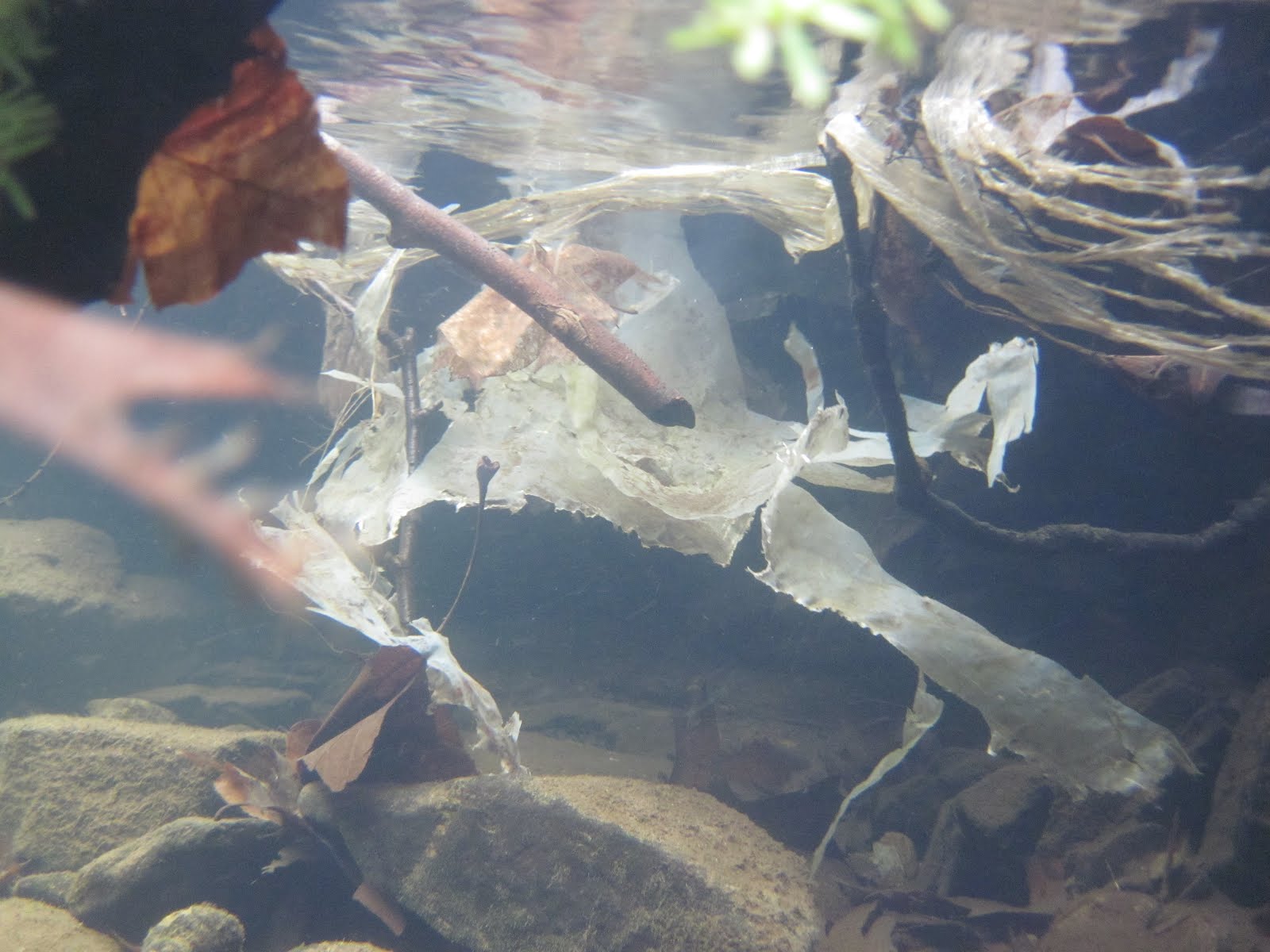
I snagged the wrapper and continued on my exploration of this creek. I looked towards an undercut bank with a good amount of woody structure hanging into the hole. Excellent habitat for trout. Instead I found plastic tangled in the branches and roots of a hemlock. I snorkeled into the hole, and removed the trash.
I saw some young trout and an amazingly colorful sculpin on this trip. And these fish made this experience memorable. But what really impacted me was the empowerment that came from removing a few pieces of trash from this beautiful creek, and how those actions can translate into others that will also protect our rivers and streams. Get out there, enjoy your local creek, and take a few steps to protect it. Whether that means driving less, getting involved in issues that affect it, or even just picking up a few pieces of garbage. It all adds up, and it all matters.
Wednesday, January 9, 2013
First Ice
It’s nice to see ice on the creek. Not that I necessarily enjoy snorkeling in freezing water. But I wonder if ice will become a thing of the past, a legend, and if I will tell stories of how our creeks used to freeze, and how we played hockey on the neighborhood stream to my grandkids the way my grandfather used to tell stories of how the Raritan used to ice over so thick you could drive across it.
I try not to be an alarmist, but some of the things changing in the environment are concerning, and one of them is the lack of ice on our rivers in winter. Granted I can’t make any kind of climate statement based on a few years of evidence, but I really do hope for a good freeze this year. It’s been a while.
Climate change is happening whether I can see the evidence or not. The scientific jury that had been out on the subject reconvened and while not unanimous, the large majority determined that there is indeed enough solid data to say that yes, the climate is changing. The fact that the climate is changing doesn’t scare me. That’s what climates do. Where do you think all the coal in Pennsylvania came from? From when Pennsylvania was a humid swamp 300 million years ago during a period that lasted for 34 million years, when its climate was much more tropical. What I fear is the rate of this change. I can see changes in my lifetime, changes that should take much, much, longer. It’s hard to deny that we have sped up the process with our fossil fuel addiction.
I fear changes to our climate mostly for selfish reasons. I don’t want to see our streams change before I know them. After years of snorkeling the same creeks I feel like I am just now beginning to understand them, how life adjusts to season, how fish respond to rains and droughts, how the creek changes with flow. There are so many streams to snorkel at different times of day in different seasons, I can never see it all. Forget about even trying to understand it all. And now that I have just barely scratched the surface of really understanding the ecology of a handful of creeks, it stands to change dramatically.
Cold water fisheries may be no more, community composition will change. Breeding ecology of a lot of species is based on water temperatures. Exotic species whose spread is partly controlled by colder temperatures are primed to expand their range with mellow winters. Hydrology will probably be altered, maybe to feast or famine, flood and drought without much in between. This isn’t doom and gloom, because life will find a way. But it will probably be different, and possibly before I have had the chance to watch and learn the current system.
But right now the cold water is piercing my cheeks and I really can’t feel if the snorkel is still in my mouth. I’m not choking on water so it must be, but my lips aren’t working quite right. The future will bring change, and we need to modify our behaviors to slow its rate, but I can still appreciate what is before me in the present. And right now that is a school of minnows swimming under a sheet of the first ice of the season.
Saturday, January 5, 2013
Clarity
I have been grieving the loss of a teenage patient for the last few days, since he died on New Years. I was the paramedic on a bad call where a young man died in spite of our best efforts, and I have spent at least part of each day since trying to figure out why. It never makes sense to me when someone young dies. But I didn’t come to Big Branch to sort out life’s mysteries. My motives were much more simplistic. I came here because it’s been a few weeks since I snorkeled one of my favorite creeks. We perceive that life ends when winter starts, but that’s far from true. Life is abundant, just a little less noticeable in winter, and the same holds true for the wintertime life in our rivers and streams.
I knew getting into the freezing water was going to be painful, and it was, but the stinging subsided and I relaxed. The water was cold but bearable. Life immediately became apparent. A sculpin darted toward the shoreline, and before I could get my camera into position, it disappeared into the surroundings. This fish is so well camouflaged the only way I would see it again is if it moved, and it didn’t. A school of some kind of minnow swam out from under the beginnings of an ice sheet.
Two large fall fish came in for a closer look at me. I love these fish. They’re big year round chubs, always here in every season, just in different spots. They aren’t too skitterish, and seem as curious about me as I am about them so we usually end up floating together as we watch each other for a while.
I didn’t last too long. The cold forced me to get out just as I lost feeling in my hands. But I was in the water long enough to know that life here was abundant and thriving. Maybe not as much as in summer, but I certainly didn’t have to search to find it. The perceived end that winter brings is just that, a perceived end, not a real one.
The trip to Big Branch didn’t give me any great perspective on this death. It didn’t answer any great universal mystery. But for 30 minutes I didn’t think about it, and I got out of the water with the reassurance that life finds a way, that we are part of a much larger whole, and that it would be ok. There is a reassuring permanence in our streams. Maybe death is like winter, a perceived end, not a real one. I knew getting into paramedicine would be painful at times, just like I knew getting into this winter stream would hurt. I’m glad I did both.
Monday, December 31, 2012
Where There Is A Will There Is A Way
I spent a lot of 2012 wishing for clear water. The more I creek snorkel, the more I realize how degraded the water in our rivers and streams has become because of the things we do on land. Most streams turn chocolaty brown after just a quarter of an inch of rain, and some stay too murky to snorkel for days, even weeks, after a good rain. I depend on clear water to snorkel and it just felt like this year was a year of muddy water, again. It wasn’t until I ran a trip with the National Aquarium that I realized where there is a will there is a way.
We had a line of typical summer afternoon thunderstorms move through our region the day before the trip. A lot of the rain hit land that we disturbed which resulted in soil clouding the runoff, and our streams. A lot of the water ran from hard surfaces like roads, driveways and rooftops which scoured more soil into our streams. The result was really murky water in the stream where I planned to take this group snorkeling. I decided we would try the Susquehanna first. The river usually experiences very slow flows in the summer, and the water gets very clear. We slipped into the river below Conowingo dam and watched a herd of Virginia river sails graze algae off rocks, watched a few sunnies defend their nests, and saw the shadows of a few smallmouth bass stay just barely in view. Conowingo started to generate power and released water. The warning lights went off, the increased flow kicked sediment into the water which reduced visibility, so we left. I still had a half a day of snorkeling to fill and was out of options, I thought. We went to Deer Creek, our usual go to, and as assumed earlier in the morning, it was brown with sediment. As the group ate lunch I scoped out a smaller tributary to the Susquehanna. It is a rocky, boulder strewn creek, barely 10 feet wide that tumbles down the hills of the lower Susquehanna valley. It’s not very deep, maybe a foot in a few holes, but the water ran clear. We explored this small tributary after lunch, and watched an entirely different aquatic community of blacknosed dace, common shiner and crayfish function.
As the year ended I found myself in the same situation. Every time my schedule opened up to allow a snorkeling trip, it rained, our rivers got muddy and I got frustrated. Then I checked some of the smaller steams, and they ran clear.
I got into the water, experienced the familiar but always awe inspiring force water exerts even in this small stream, and was transported into another realm. As I hovered in the creek, a darter shot from beneath me and let the current wrap its body around another rock. Caddisfly larvae grazed. I floated and watched until I started to shiver in the barely above freezing conditions. This water isn’t as big, and the larger fish and fish schools aren’t here, but there is amazing life to see in the smaller tributaries.
It’s easy for me to get pessimistic about the future of our aquatic environments when water clarity depends on a drought. But finding clear water to snorkel gives hope. In this season of making resolutions, I resolve to not let muddy water get in my way of exploring rivers and streams. We all need to resolve to take the actions necessary to protect our surface waters and all the amazing life it contains. Where there is a will there is a way.
Monday, December 24, 2012
Rock Tornados
We got an inch and a half of rain which raised the level of this stream by four feet, and turned it to chocolate milk. Three days later the water wasn’t as murky and the water level dropped but the flow was still greater than what I was used to at this spot.
The water was hazy but clear enough to see the bottom. I hung onto edges of boulders as I crossed the rapid to the far shore, and felt like a leaf in a hurricane. Sand gathered in large mounds in the lee of shoreline rock, and a few minnows lazily drifted from their protective eddies. The higher velocity water rearranges the parts of the bottom it can and tornados of sand and rock swirl in eddies behind boulders. The water has uprooted some Asian clams from the bottom and piled them with a mound of pebbles behind a rock. Part of the bank is cut deeper and more tree roots are exposed. I watch the river shape itself as I creep upstream. There is a feeling of permanence that comes with watching a river. Rain falls, rivers rise, water wears away rock. This stream was here long before I was, and it will be here long after I am gone. In the mean time I get to share some moments in its current and I feel completely free as I drift downstream through the rapid, entirely at the mercy of the water. It’s reassuring and life affirming to know that there are things much larger than I at work in the world, and I get to play a small role. Most times snorkeling is about watching life. This trip was about watching the immortal processes that make life in streams possible.
Tuesday, December 18, 2012
Furry Rivers
I was just here three weeks ago and it didn’t look anything like this. Everything is covered in a fluffy algal fur. The angulated lines of the rocks that make up this rapid are softened and billow in the flow. The fast moving water mashes the algae to the boulders and form a mosaic of quarter sized green and brown patches that quiver in the current. If I didn’t know I was in Deer Creek, I could easily mistake my surroundings for another planet, it looks so alien.
This is a normal seasonal progression for our streams. We see an explosion of algal growth when the balance of nutrients, sunlight and grazing is thrown off center with autumn leaf fall, and colder temperatures. Deciduous trees drop their leaves each fall and many of them end up in streams. This increases the amount of sunlight reaching our streams and increases the amount of nutrients in our creeks, which create conditions excellent for an explosion of algal growth. At the same time, temperatures drop, and algae grazing insets reduce their activity, so the streams control mechanism of excess algal growth stalls. The system gets temporarily off balance, algae cover everything, and our rivers get furry.
We are familiar with the terrestrial passage of the seasons, and maybe take how life responds to changes in sunlight intensity, which affects temperatures, for granted. It is a more pronounced change in our streams because we don’t live there. Even though streams are familiar, their underwater views are foreign so changes appear less subtle, more dramatic and more easily noticed. What most people don’t recognize, and I often forget, is that streams have seasons too.
Time goes on, and seasons come and go, even in our rivers and streams. I feel fortunate to watch the underwater seasons pass, generally in step with and definitely linked to the terrestrial ones, which ultimately are affected by cosmic events. But the underwater seasons of our rivers and streams are unique in how they present, and I get to witness the otherworldly seasonal progression.
Subscribe to:
Posts (Atom)